 By
By Germany is considered one of the world’s top learning destinations for both international and local students to study engineering.
Universities in Germany combine strong academic training with modern research, innovative technology, and deep connections with industries such as automotive and IT.
The low-to-no tuition fees policy of public universities makes Germany an attractive place for international students, but they still need a budget for accommodation, project contributions, or other needs. Students must also research the programme they are applying for to learn about any admission requirements.
It’s better to start planning early if you want to study engineering in Germany. This blog aims to help make this process easier for you.
Why Is Germany the Best for Engineering Studies?
Germany is best for studies, especially STEM education (science, technology, engineering, and mathematics), for many reasons.
There are multiple options across bachelors, masters, and doctoral programmes in engineering fields that offer practical learning combined with research. Germany also offers a growing number of English-taught engineering programmes, particularly at the masters level, making it an attractive study destination for international students.
Did You Know?Germany is becoming increasingly popular as an international study destination, with students from countries such as the USA and China choosing to pursue higher education there at above-average rates. |
For further academic support, students can also seek professional help from a trusted assignment writing service.
The leading engineering fields are as follows:
- Mechanical engineering
- Electrical engineering
- Computer engineering
- Civil engineering
- Automotive engineering
- Renewable energy
Here are the five major reasons why you should choose German Universities:
Quality Education:
German technical universities have international recognition.
Research & Technology:
Universities emphasize areas such as AI, robotics, energy, and advanced manufacturing.
Industry Connections:
Engineering schools have links with major companies and research organisations and equip students with industry-focused skills.
Career Opportunities:
Germany has a large engineering and manufacturing sector with ever-evolving industries.
Affordable Study Options:
Almost 70% of public universities have zero tuition fees.
List of Top 10 Engineering Universities in Germany
The table below features German universities that come under the top-ten best engineering universities, with scholarship availability and English-taught programmes:
| Rank | Instituion | City | Average Fee | Engineering strengths |
|---|---|---|---|---|
| 1 | Technical University of Munich (TUM) | Munich | €0–€6,000+/semester | Mechanical, electrical, robotics, and computer |
| 2 | RWTH Aachen University | Aachen | Mostly semester contribution | Mechanical, automotive, electrical, and production |
| 3 | Karlsruhe Institute of Technology (KIT) | Karlsruhe | €1,500/semester for many non-EU students | Mechanical, chemical, materials, and electrical |
| 4 | University of Stuttgart | Stuttgart | €1,500/semester for many non-EU students | Automotive, Aerospace, mechanical, and civil |
| 5 | TU Berlin | Berlin | Mostly semester contribution | Electrical, computer, mechanical, and civil |
| 6 | TU Dresden | Dresden | Mostly semester contribution | Electrical, microelectronics, and civil |
| 7 | TU Darmstadt | Darmstadt | Mostly semester contribution | Computer, mechanical, electrical, and civil |
| 8 | FAU Erlangen-Nürnberg | Erlangen/Nuremberg | Mostly semester contribution | Electrical, electronics, materials, and mechanical |
| 9 | Leibniz University Hannover | Hannover | Mostly semester contribution | Mechanical, civil, electrical, and aerospace |
| 10 | Hamburg University of Technology (TUHH) | Hamburg | Mostly semester contribution | Mechanical, civil, process, and electrical |
Note: Tuition fees or other costs may vary significantly by programme, degree level, and nationality
Technical University of Munich:
|
Did You Know?It is one of Germany’s best-known technical universities, has several main campuses beyond central Munich, and operates a branch in Singapore. |
RWTH Aachen University:
|
Did You Know?Its prime location near Belgium and the Netherlands gives the city a distinctly international appeal. |
Karlsruhe Institute of Technology:
|
Did You Know?KIT combines university education with the research tradition of a major national research centre. |
University of Stuttgart:
|
Did You Know?Stuttgart is closely associated with the automotive industry and is home to major automotive giants, including Mercedes-Benz and Porsche. |
Technische Universität Berlin:
|
Did You Know?Berlin combines traditional engineering research with one of Europe’s biggest start-up infrastructures. |
TU Dresden:
|
Did You Know?Dresden is home to Europe’s largest microelectronics cluster, known as Silicon Saxony, which hosts over 500 semiconductor and tech companies. |
TU Darmstadt:
|
Did You Know?Darmstadt is often called a major science and technology city in Germany. |
FAU Erlangen-Nürnberg:
|
Did You Know?Its location connects students with the industrial and technology corridor around Erlangen and Nuremberg. |
Leibniz University Hannover:
|
Did You Know?Hannover has a long engineering and industrial tradition and hosts major technology and trade events. |
Hamburg University of Technology:
|
Did You Know?It is one of Germany’s best-known technical universities, has several main campuses beyond central Munich, and operates a branch in Singapore. |
Best Engineering Specialisations in Germany
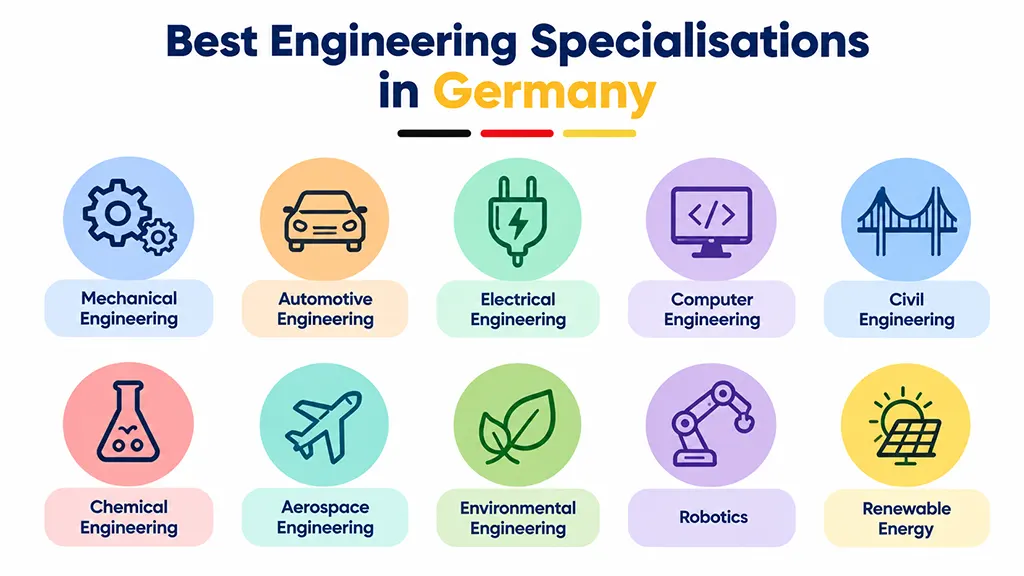
- Mechanical Engineering: Machines, manufacturing, mechanics and industrial systems.
- Automotive Engineering: Vehicle design, electric vehicles and mobility technology.
- Electrical Engineering: Electronics, power systems, automation and communication.
- Computer Engineering: Hardware, software, embedded systems and computing.
- Civil Engineering: Buildings, roads, bridges, construction and infrastructure.
- Chemical Engineering: Industrial chemical processes, materials and production.
- Aerospace Engineering: Aircraft, spacecraft and propulsion systems.
- Environmental Engineering: Waste, water, pollution control and sustainable infrastructure.
- Robotics: Automation, intelligent machines and industrial robots.
- Renewable Energy: Solar, wind, energy storage and sustainable power systems.
Best Engineering Universities in Germany by Specialisation:
| Engineering Fields | Best Recommended Universities |
|---|---|
| Mechanical | TUM, RWTH, KIT, Stuttgart |
| Automotive | RWTH, Stuttgart, TUM |
| Electrical | TUM, RWTH, KIT, TU Dresden |
| Computer Engineering | TUM, TU Darmstadt, TU Berlin |
| Civil | TUM, RWTH, TU Dresden |
| Aerospace | Stuttgart, TUM, RWTH |
| Renewable Energy | TUM, KIT, TU Dresden |
| Chemical | KIT, TUM, RWTH |
| Robotics | TUM, RWTH, TU Berlin |
How to Apply for Engineering in Germany
Applying to an engineering university in Germany involves a few important steps. International students should:
- Choose a programme and university that matches their academic background and career goals.
- Check the admission requirements, including qualification recognition, language requirements, and programme-specific criteria.
- Prepare the required documents, such as academic transcripts, certificates, passport, CV, and motivation letter if required.
- Submit the application through the university portal or uni-assist, depending on the university and programme.
- Wait for the admission decision and, if accepted, follow the university’s instructions for enrolment and further steps.
For the most recent application dates and document requirements which can differ depending on the program and university students should always visit the official university website.
General Admission Requirements for Engineering in Germany
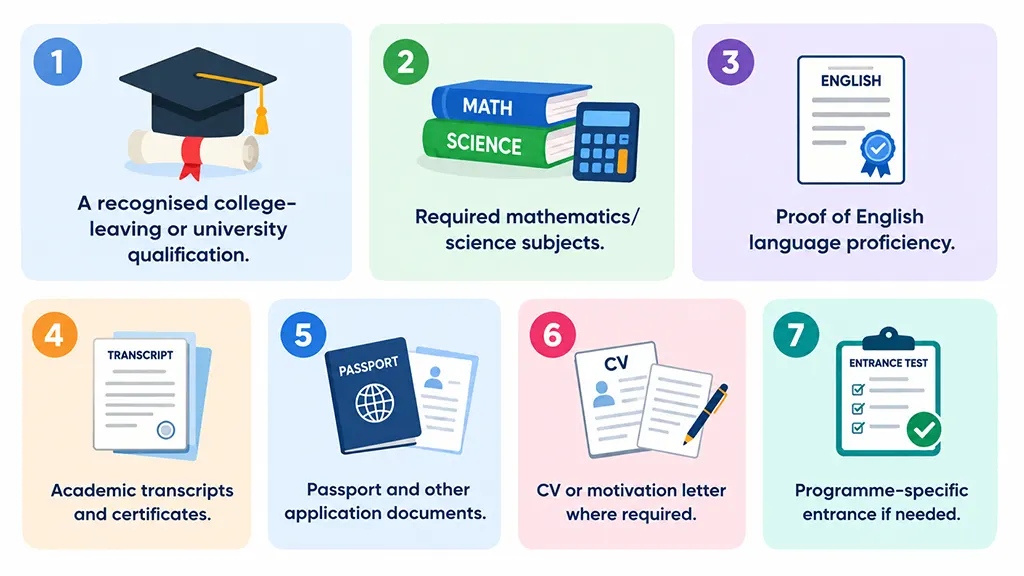
When applying, remember that the following requirements vary by university and programme:
- A recognised college-leaving or university qualification.
- Required mathematics/science subjects.
- Proof of English language proficiency.
- Academic transcripts and certificates.
- Passport and other application documents.
- CV or motivation letter where required.
- Programme-specific entrance if needed.
It is recommended that international students check whether their qualification provides direct university admission.
Engineering in Germany After 12th / High School
You can study a bachelor’s degree in engineering in Germany, but finishing the 12th grade doesn’t automatically secure direct admission to your preferred university programme.
Your qualification is assessed according to German higher-education entrance requirements. Some students may require a preparatory programme called a Studienkolleg. According to DAAD, these courses can provide the academic and language preparation needed before university study. For instance, students whose qualifications do not provide direct entry may need to complete a technical preparatory course and pass the Feststellungsprüfung.
Tuition Fees & Cost of Studying Engineering
Go for public universities if you’re seeking a high-end educational experience within your budget, as most master’s and bachelor’s programmes are free in public universities.
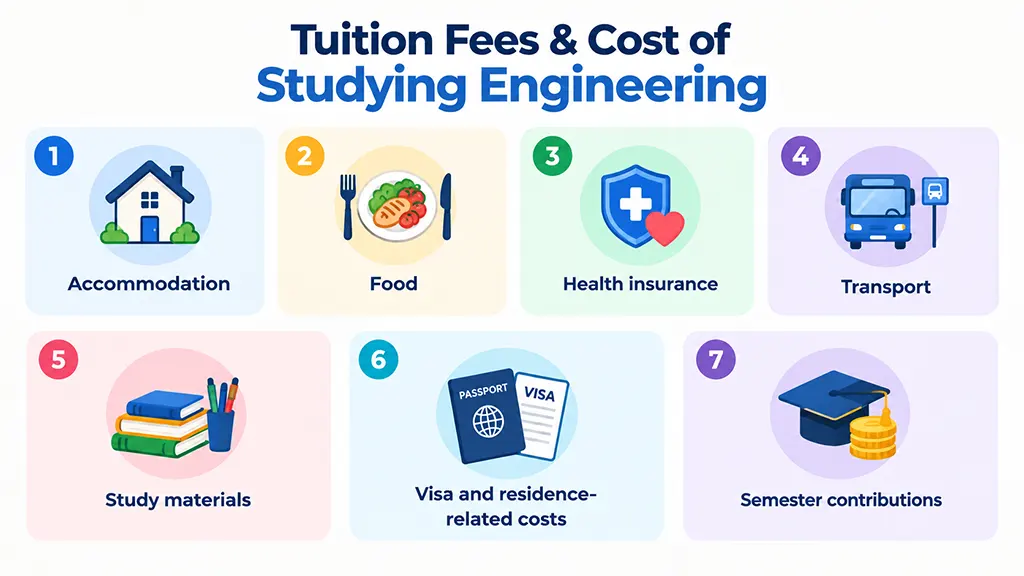
However, students are required to plan a budget for:
-
- Accommodation
- Food
- Health insurance
- Transport
- Study materials
- Visa and residence-related costs
- Semester contributions
Scholarship Opportunities for Engineering Students
International engineering students can explore:
- DAAD scholarships
- Deutschlandstipendium
- University-specific scholarships
- Foundation scholarships
- Industry-sponsored funding
English-Taught Engineering Programs
Yes, Germany has many English-taught engineering programmes, particularly at master’s level. At bachelor’s level, the choice is smaller, so students should search carefully.
If you do not speak German, an English-taught degree can make studying easier. Plus, you can seek assignment help in Germany to understand university requirements and formatting rules for academic coursework. However, learning basic German is still useful for daily life, internships, and future employment. Always check the programme page for the actual teaching language.
Career Opportunities After Engineering in Germany
Engineering graduates can find opportunities across sectors such as:
-
-
- Automotive industry: Vehicle design, EVs and mobility.
- Mechanical/manufacturing: Production, machinery and automation.
- IT & technology: Software, AI, embedded systems and data.
- Renewable energy: Solar, wind, batteries and energy systems.
- Robotics: Industrial automation and intelligent machines.
- Aerospace: Aircraft, spacecraft and propulsion.
- Electrical engineering: Electronics, power and automation.
- Research & development: University, industrial and laboratory research.
- Engineering consulting: Technical design, project management and problem-solving.
-
German language skills can be a major advantage when looking for internships and jobs, even when your degree was taught in English.
Best Cities in Germany for Engineering Students
Munich
Home to TUM and a huge technology and engineering hub. Great career opportunities, but living costs are high.
Aachen
It has a strong student atmosphere and excellent engineering-industry connections.
Berlin
A good choice for students interested in technology, start-ups, and innovation. Housing can be competitive.
Stuttgart
Excellent for automotive, mechanical, and aerospace engineering. Living costs are higher than in some smaller German cities.
Karlsruhe
KIT makes Karlsruhe a strong research and technology hub. It offers a more manageable student environment than Germany’s largest cities.
Dresden
A strong choice for electronics, microelectronics, and technology. Living costs can be comparatively attractive.
Darmstadt
A science-focused city with TU Darmstadt and strong links to technology and research.
How to Choose the Right Engineering University in Germany?
-
-
- Engineering specialisation: Choose a university that is strong in your specific field.
-
- Mode of Communication: Check whether the degree is taught in German, English, or is bilingual.
-
- Tuition and semester fees: Especially important for non-EU students.
-
- Living costs: Munich and Stuttgart can be much more expensive than smaller cities.
-
- Admission requirements: Check your qualifications before applying.
-
- Industry connections: Look for universities with strong company partnerships and internship opportunities.
-
- Research opportunities: Important if you plan to pursue a master’s or PhD.
-
- Career prospects: Consider the industries located around the university.
-
Final Thoughts:
If you aim for a long-term career in a country where you can get excellent education, find advanced research programs, and get the best job opportunities, choosing an affordable public university in Germany is a wise decision.
Frequently Asked Questions (FAQs)
Which is the best engineering university in Germany?
There are several universities in Germany that offer the best engineering programmes; however, the Technical University of Munich (TUM) and RWTH Aachen University have high national rankings.
What are the top 10 engineering universities in Germany?
- Technical University of Munich (TUM)
- RWTH Aachen University
- Karlsruhe Institute of Technology (KIT)
- Technical University of Berlin (TU Berlin)
- TU Dresden
- University of Stuttgart
- Technical University of Darmstadt
- Friedrich-Alexander University Erlangen-Nürnberg (FAU)
- Leibniz University Hannover
- University of Freiburg findamasters.com
Which university is best for engineering in Germany for international students?
Technical University of Munich (TUM)
Is engineering free in Germany for international students?
Most public universities offering engineering programmes in Germany require zero tuition fees for international students.
Can I study engineering in Germany in English?
Yes, most master’s programmes of engineering are taught in English.
What are the requirements to study engineering in Germany?
Students usually need academic qualifications, language proficiency and a valid student visa.
How much does it cost to study engineering in Germany?
Costs depend on the university and state. Students also need to budget for living expenses.
Which engineering course is best in Germany?
Mechanical, electrical, automotive, civil and computer engineering are popular choices.
Can I study engineering in Germany after 12th?
Yes, eligible students can apply after completing their secondary education and meeting university requirements.
Do I need German language for engineering in Germany?
Not always. Many programmes are taught in English, while German is useful for daily life and some courses.
How can I get a scholarship for engineering in Germany?
Students can explore university scholarships and funding programmes based on eligibility and academic performance.
Which engineering field is in demand in Germany?
Mechanical, electrical, software, automotive and renewable energy engineering have strong demand.
What is the cost of living for students in Germany?
Living costs vary by city but usually include accommodation, food, transport, insurance and study expenses.
Can international students work while studying engineering in Germany?
Yes, international students can work subject to the applicable student employment rules.
What are the career options after engineering in Germany?
Graduates can pursue careers in engineering, technology, manufacturing, research, automotive and renewable energy.


