 By
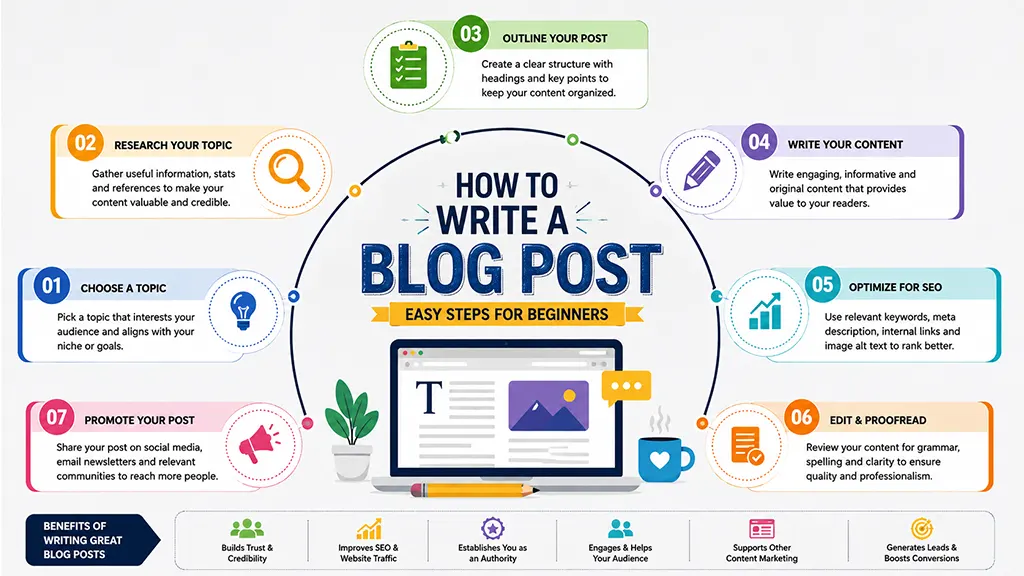
By One of the most powerful tools for people and businesses to share ideas and progress online is a blog.
Blogs hold a unique place in the digital landscape, in a world where content creation has become a business of its own.
There are many reasons blogging matters: it creates your digital home, shares your unique voice, and creates long-lasting value.
However, many beginners struggle due to slow early outcomes and steep technical learning curves. Blogs require plenty of time and effort.
While plenty of businesses ask the question, what is the aim of a blog, according to research. Hence, it is clear that there are still some issues out there, and many businesses do not know the aim of blogs.
Whether you are a beginner, student, or small business owner who wants to learn about blog writing and how to write a good blog post to catch the attention of audiences, this guide is for you.
Let’s begin the article.
What is a Blog?
According to reliable research, almost 80% of internet users constantly read blogs every day. More than 600 million blogs online, and roughly 7.5 million new ones are being published every day.
That is the power of blogging, and it is rising day by day, and there will never be an end to blogs.
To understand what a blog is in easy words, it is basically an online platform where you can share your ideas, thoughts, and knowledge with others in a certain field.
It is similar to a digital journal that works in reverse chronological order. It means the latest posts are noticeable first to the audience.
In addition, blogs motivate learners to share ideologies and structures with people, which can lead to chats in the comments section.
Purpose
The main aim of writing blogs is to inform readers, share information, and engage with them. It can also support personal or business aims through consistent blog post publishing.
On the flip side, the aims of blogs differ; many blogs are made to inform, engage, or grow an audience over time.
Here are the different aims of blogs and what owners normally wish to:
- Engage with people and create an online community
- Share knowledge and display expertise
- Help business and marketing aims
- Provide creators plenty of space to grow and publish
Different Types
Here are the different kinds of blogs with relevant examples.
1. Listicles (List Posts)
Listicle posts organize info into an easy, numbered or bulleted list that is exceptionally simple to read and skim.
- Example: Top 10 Tools for Strong Time Management
2. How-to Guide
In a how-to guide, bloggers provide step-by-step guidance to support and educate readers in mastering a new skill or completing a particular task.
- Example: How to drive a car for the first time
3. Personal Stories
Personal blogs are generally made to tell personal stories, share real-life events, or keep travel logs in a friendly, conversational tone.
Bloggers use firsthand expertise while writing a personal blog post.
Example: What I Studied Traveling Alone in the UAE for a Month.
4. Reviews and Affiliate Posts
Product reviews and affiliate posts are an effective way to make money online without having a single subscriber or any present traffic.
Bloggers aim to help customers make a wise choice by producing reviews and affiliate posts about whether or not to purchase the product.
Example: The Best Gaming Laptops of 2026
Why Blog Writing Skills Matter
In this era where information rules supreme, valuable blog writing is more than a skill these days.
It is a strategic device that can take your brand into the new world. You can easily drive tons of traffic every day by offering a compelling post.
Blog writing skills are essential because they assist you in connecting with readers, creating trust, and increasing search engine rankings.
Here are the key reasons why writing blogs matters.
1. Education
Producing blog posts helps teachers and schools share valuable information with learners.
Clear posts make challenging ideas easy to understand. Tutors can post additional notes, and students can read them anytime, which can improve their performance in school.
2. Business
These days, firms leverage blogs to show clients and customers what they do and why their services can be the ideal choice for them.
Moreover, strong and helpful posts answer all of the common questions of buyers. And it displays industry understanding.
Consequently, this creates trust, and more and more people purchase the company products by using the company website. And many customers become loyal clients.
3. Personal branding
A personal blog is a unique way to share your unique abilities, expertise, and voice to the world. You can talk about anything and guide readers to travel tips, share lifestyle choices, wellness tips, and share DIY tips.
4. Marketing
Lastly, blogs are a rich and powerful tool to help a brand bring its content to search engines. Every time you write a new post, it offers search engines fresh and new content to display to people who are seeking answers.
So, you can also share your posts on social media, and your brand will grow. And it supports you in selling your products.
If you want to develop your writing skills and want to pursue a career as a full-time blogger, connect with a specialist and a maven Dissertation Writing Service. These reputable services work with certified and experienced tutors who are subject matter experts. Our tutors will teach you step by step how to become a blogger in 2026 and start a lucrative career.
Prepare Before You Start Writing
According to Jodi Picoult, a renowned American bestselling author,”You can always edit a bad page, but you cannot edit a blank page.”
It means you need to add content to your page, no matter how bad it is in the first draft. Before that, you have to prepare your writing.
To prepare your blog post, you need to do your own research, like finding the right keywords, understanding and defining your audience and aims, and, lastly, analyzing the search intent.
Let’s describe in detail how to prepare before writing.
1. Research
- Study competitors- To start research, you need to search for top-ranking articles on your topic in order to find gaps. And then look for what info is missing.
- Collect facts- Now gather pertinent stats, expert quotes, and fresh examples to support and add to your main points.
- Examine sources- Once you gather data and before writing a post, you need to verify and confirm that the info must be reliable and accurate.
2. Audience
- Classify readers- Understand who will read your post, what they think of when reading your blog post. And what issues they are aiming to solve.
- Match understanding level- You have to match your knowledge level by using correct words and clarifications that are suitable for your readers. If they are a beginner, start from the basics and teach them step by step. For industry experts, you will not need to start from the basics; they already have knowledge.
- Aim for needs- Tackle their precise pain points directly in order to keep the readers connected from start to end.
3. Search Intent
- Find the Why-You have to work out what the user wants once they type a query into search engines, Google or Bing. They come here to learn, to buy, or to find a particular page. There are 4 kinds of search intent, like informational, commercial, navigational, and transactional. You need to find out yourself. You can also blend 1 or 2, or 3.
- Match format- Now write and offer the correct content style, like a step-by-step tutorial, a quick list, or a deep review.
4. Goal
- Set a goal- You need to choose or decide what you wish the post to accomplish, such as obtaining more email signups, selling a product. Or creating brand trust.
- Plan action steps- include a clear CTA, call to action that conveys to the reader what to do next, like suggestions or future recommendations.
How to Write a Blog Post Step by Step?
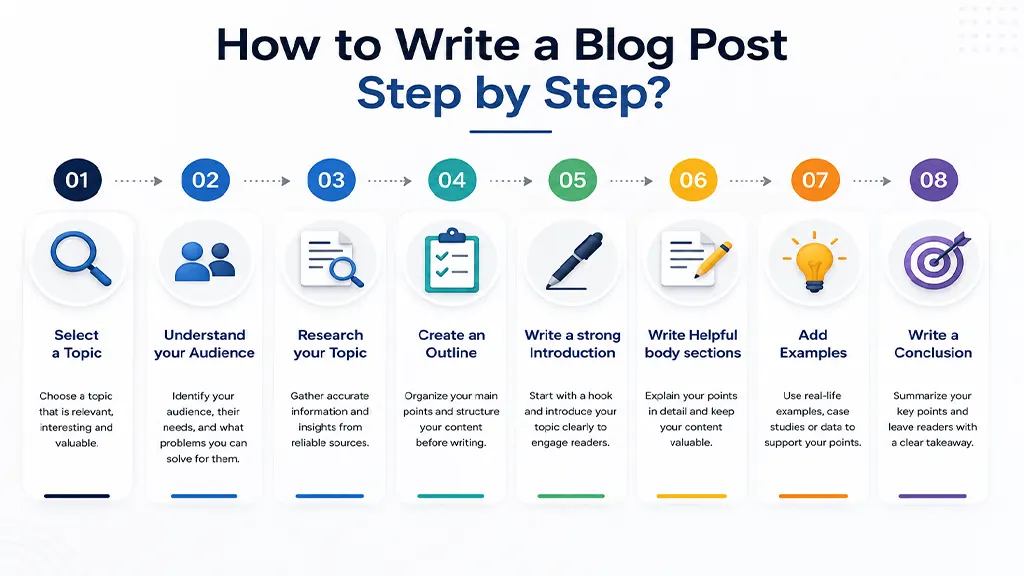
If this is your first blog or you have already produced a few and now aim to improve your practice. You need to break it down into smaller, handy steps; it will assist you in producing clear and compelling content.
Here is a step-by-step guide to writing a winning blog post.
1. Select a topic
The first step is pretty straightforward: you need to pick a topic. You need to be clear on who you are writing for and what they need to know.
Find out these.
- Are they novices, experts, hobbyists, or even professionals? The clearer you are, the simpler it is to tailor your content.
- What type of questions do they have? What issues are they aiming to explain?
So, once you choose a blog topic and figure out these, you can move to the next step.
2. Understand your Audience
You have to consider your audience who will read your blog post. Then consider what issues your readers have and what answers they require.
You can surely set the tone once you understand your target group. And the level of language in order to keep them satisfied and connected throughout the content.
3. Research your Topic
Once you begin your writing, you need to spend at least 1 hour or more researching your topic. And check out what topics bloggers cover.
Here is how you research your topic.
- For popular questions, examine the ” People also ask section of the Google results page once you look for your topic. These are authentic questions people want to respond to and answer.
- Check what Ranking-Now search at the 5 or 10 articles for your topic, like what are they covering? What questions are they missing? They do not add it
- Search for content gaps- you need to find the gaps to create fresh and unique info. For that, add your personal information and expertise.
- Finding supporting facts-Lastly, search for stats, studies, or even expert quotes to back up your points
4. Create an Outline
Before you write your blog post, you need to arrange your ideas and thoughts by creating an outline. It will save you a lot of time.
Here is a typical blog post outline.
- Intro- Catch the attention, introduce a pertinent issue or any surprising stat.
- Body- The body section must break down the topic into logical chunks. Leverage H2, H3, and H4 subheadings for skimmability.
- Conclusion or takeaway- Finalize the key points and provide the reader a next step.
5. Write a strong introduction
Your intro must catch the attention of readers; the intro must be concise, short, and catchy. Add a relevant scenario, stats, or a data point.
Among the effective techniques for an intro is AIDA (attention, interest, desire, and action)
6. Write Helpful body sections
The body section must be in detail, so break down your main ideas into clear paragraphs below your subheadings.
Moreover, use short paragraphs. Bullet lists and clear subheadings. Here is an easy recipe for crafting every section.
- Mention your main point or tip
- Clarify how to do it (if possible use a step-by-step guide)
- Add real-life events, examples, or case studies by using the EEAT technique (Expertise, experience, authority, and trustworthiness).
- Talk about why this method or strategy works
- Underline when or where to use it
7. Add Examples
To make your blog post stand out and rank on the first page of Google, you need to display practical life cases. Or you can express a short story in order to showcase your point.
8. Write a Conclusion
Finally, write a concise and strong conclusion. The conclusion must be a recap of your main points.
You need to remind your readers why this matters and why it is vital for them in their everyday lives. And then finish with a Call to Action, such as leaving a comment, sharing the page, downloading a book, or purchasing an online course.
Common Blog Writing Mistakes

Many bloggers make common blog writing mistakes, which is why their articles do not rank. And many of them struggle
These results can hurt your rankings; in the next guide, I will guide you on how to avoid these common mistakes in your blogs.
- Examples: Many bloggers share fake or even wrong facts that make people lose trust in your work. Always check the facts and info from trustworthy websites before publishing a post.
- Keyword stuffing- Google does not like keyword stuffing, and it is not 2015 where you use a keyword 20 or 30 times in a 500-word post. Keyword stuffing is about how you can use keywords naturally throughout the content. You must avoid it and, instead of repeating the same keywords, use variations, synonyms, and leverage Semantic SEO techniques.
- Long paragraphs- Readers most of the time tire of reading long paragraphs. Instead, always use short paragraphs and sentences that are easily digestible for readers.
- Weak Intro-Start with boring or slow sentences that make visitors leave your content. Your intro must be short and catchy to catch readers’ attention.
- No CTA-CTA is one huge issue; bloggers forget to tell their readers what to do next, such as download a book, leave a comment, or even purchase a product.
- Ignoring SEO- Content is attached to SEO, and even if your blog post is compelling and you add all of the info. But if you forget to add titles, tags, meta description, and relatable keywords, your post will not appear in search engines.
Conclusion
By using our valuable guidance, you will surely nail and write a blog post. I covered everything in this article; it is an effective skill no matter where you are right now. You can write your post and share your ideas with the audience.
Always research well, find the gaps, search the intent and audience, and make an outline before writing blogs.
FAQs
- How long must a Blog post be?
For beginners, the posts can be around 800 to 1500 words long.
- How regularly must I write and post new content?
Write one post or even 2 at the start in order to remain consistent.
- Do I need to add images in every post?
Indeed, you need to add at least 1 image; it makes your post engaging, and the readers will read your post eagerly.
- What is SEO?
SEO, search engine optimization, is a technique where you add particular keywords relevant to the post throughout the content; it can include both short-tail and long-tail keywords. So, the readers can find your post in search engines.
- How do I choose a good blog topic?
Selecting an engaging post begins with classifying your personal interests, assessing audience demand, and focusing on a particular niche.
- Can I make money from my Blog?
Yes, you can easily earn a lot of money later by using ads, sponsored posts, or you can even sell products.


