
 By
By Do you intend to start a blog? When you sit down to finish it all at once, you discover that you have no idea what to write about. You search Google and discover thousands of results, which further confuses you since you are still unsure of the precise subject you ought to write about.
This article can assist you in choosing a blog topic if you are a student seeking advice for your university’s student-led digital media a novice who has just made the decision to start blogging, or a company owner.
Before we get started, realise that picking a good blog topic isn’t only about making it sound intriguing. Rather, concentrate on choosing a subject that speaks to a particular issue, appeals to a certain audience, and offers relevant, original information.
Here, you can find what makes a great topic, 10 practical steps to choose a blog topic, a checklist, tips to validate a blog topic, and you can also find some sources you can use to find blog ideas.
Let’s begin our insightful conversation!
What Actually Makes a Good Blog Topic?
Good blog topics answer a specific problem, align with your target audience’s concerns, provide useful information, and spark curiosity in readers.
If, in the middle of choosing your blog’s topic, you are thinking about what exactly makes a blog topic good, I have included a brief explanation. You can consider a blog topic good if
- It not only resonates with your target audience but also answers the specific questions your intended audience or your brand’s customers are asking.
- It provides a unique point of view or angle on a commonly discussed topic.
- It makes your targeted readers curious and eager to gain more insights.
- It gives them useful information, such as a how-to guide or tips that they can use immediately.
10 Insightful Steps to Choose Your Blog Topic

If you are wondering how to choose a blog topic, you have clicked on the right guide. Here, I have included a step-by-step process that can help you understand the entire process behind blog topic selection.
1. Clearly Define Your Target Audience
Before choosing a topic, ascertain exactly who you are writing for. Consider factors such as their age, level of education, profession, experience, interests, and subject-matter competence.
For instance, if university students between the ages of 18 and 25 are your target audience, you might take their hobbies and academic background into account when choosing a topic.
2. Start With Your Knowledge, Experience, and Audience Relevance
You should never underestimate the power of your knowledge, interests, and personal experience to generate blog topic ideas. What I mean is, when you think about the subjects you are highly familiar with or genuinely enjoy delving deep into.
By thinking of familiar topics, you can conduct research and write more easily. Moreover, writing an idea you already know much about can help you add more useful insights.
3. Identify the Concerns or Problems of Your Intended Readers
Once you have identified them, identify the specific problems, questions or knowledge gaps that your target audience requires help with. Look through customer queries, FAQs, Quora, Reddit, and other relevant communities to learn what your audience is asking.
For instance, university students could find it difficult to balance assignments and tests, which could result in a topic like “How to Manage University Assignments During Exam Season”.
4. Conduct Keyword Research to Discover What People Are Searching For
You should keep in mind that keyword research can help you explore what people actually search for related to your field. It can also help you move beyond assumptions by letting you create topics based on real data.
You can use the following tools to discover relevant search terms (keywords) related searches, and even get potential topic ideas:
- Semrush.
- Ahrefs.
- Google Keyword Planner.
- AnswerThePublic.
- Moz Keyword Explorer.
5. Make Sure to Check Search Intent
Make sure you know what people are looking for when they search for a blog topic before choosing one. For instance, if you want to write on student productivity, type the term on Google and examine the top results.
If most are guides, tips, or how to articles it suggests that users are looking for informational content. Choose a topic that matches this intent.
6. Analyse the Blogs and Other Content of Your Competitors
The next step is to review the blogs and other content your competitors cover. It will help you understand what topics they actually pay attention to and what kind of information they provide.
Remember, instead of copying ideas, you have to find gaps, unanswered questions, or points they have not covered. This way, your blog topic will target the exact missed query or problem that people genuinely want more information about.
7. Choose a Topic Based on a Specific Concern, Question, or Query
Rather than choosing a broad topic that has a large spectrum of information to cover, you should focus on a specific question or concern. Selecting a broad topic can make it difficult for you to decide what you should eliminate or include, and it also increases your chances of missing out on important gaps.
That’s why it is better to pick a specific question so that your topic provides a clearer purpose and targets a more particular audience.
8. Don’t Forget to Cover a Unique Angle
You can add value to your chosen issue by taking a distinct approach, even if it has already been covered by other blogs. Examine what rivals have already covered and think about whether you can address an audience, query, or viewpoint that has been neglected.
Suppose you want to write about study-life balance and healthy habits. You find plenty of blogs covering healthy habits, but notice that many of them don’t focus on habits that support mental health.
You can use this gap as an opportunity and focus your topic on healthy habits that improve mental well-being.
9. Select a Topic that Offers Long-Term Value
Ask yourself, ‘How long is my selected blog topic likely to remain useful for my target readers?’
Here, you should choose a topic based on your goals and audience ideally, one that can provide value for years to come. or a seasonal topic that is relevant during a particular time. Additionally, you must understand that a trending topic may seem like a great chance to attract attention quickly, but it may not remain relevant after some time.
You must choose between these by considering what your audience actually wants and the type of content you plan to create.
10. Make Sure Your Blog Topic Provides Real Value
Lastly, you should choose a topic that you can provide proper, insightful information on. What I mean is, when you pick a topic with this approach, you can keep your content accurate and more helpful for your readers.
Where Can You Find Blog Topic Ideas?
After you understand how to choose a topic for a blog, the next question to pop up in your mind must be where you can find topic ideas for your blog. You can easily find a blog topic idea from:
People Also Ask Section in Google Search Results
Have you noticed how particular the queries in Google’s ‘People Also Ask’ section are?
Consider this example.
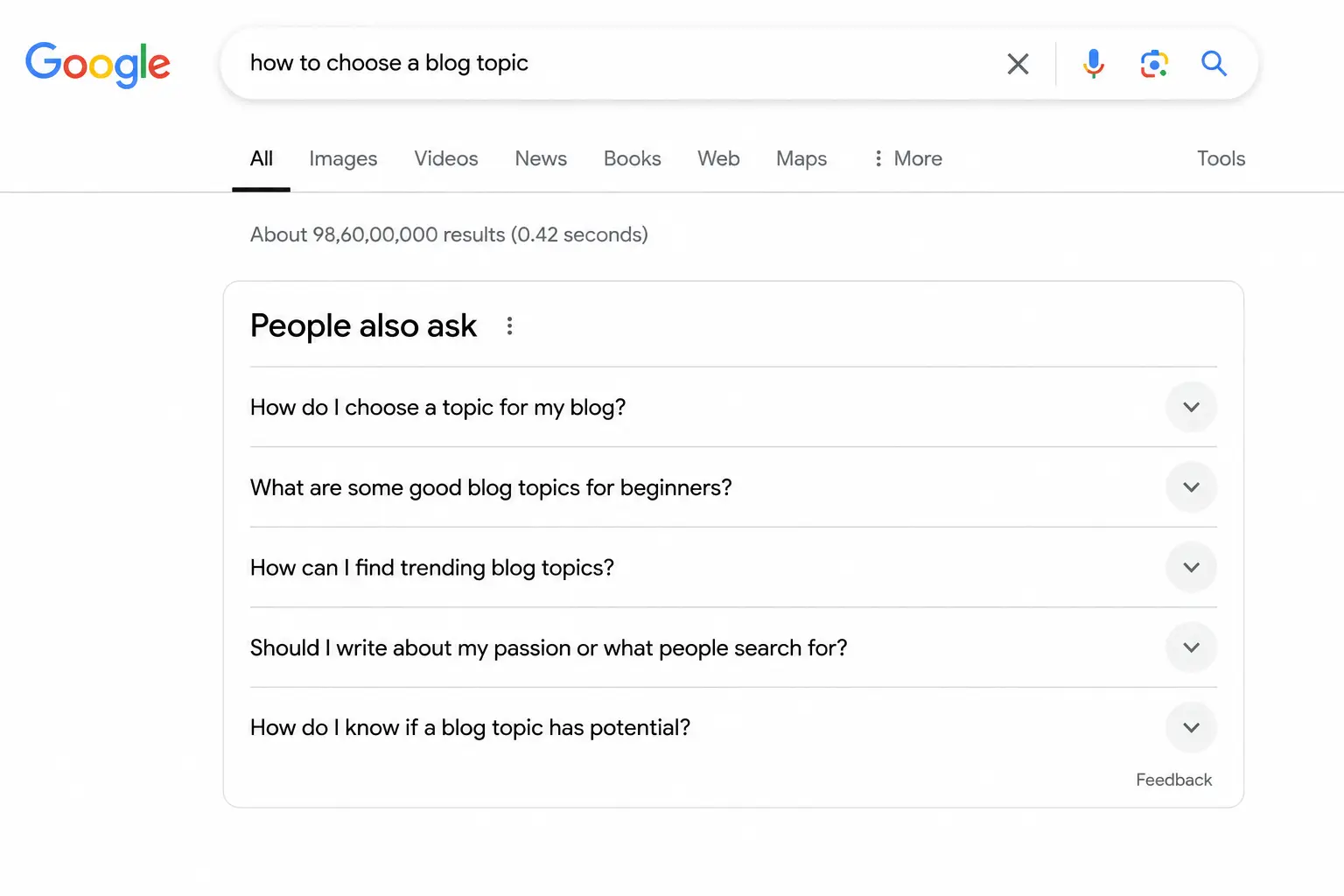
Among other results, these are some of the queries people search for related to the keyword. You can also search for a product or service and use these questions as your blog content ideas.
Google’s Autocomplete Feature
Other than Google’s ‘People Also Ask’ section as your source, you can also use the Autocomplete feature to find a blog topic. Suppose you type a keyword in your search bar without hitting Enter. Google Autocomplete can reveal common search phrases and related queries that may help you discover potential blog topics. It can aid you in finding more relevant topics that you can modify and use for your blog topic.
Online Community Forums
After you are clear about how to choose a blog topic, you can search your niche, service, or a similar product as yours on Quora, Reddit, or other community forums to find what specific problems or answers your target readers want to solve or know.
Your Competitor’s Blogs
I am not saying you should copy your competitors’ exact blog titles. Instead, you have to review and identify the gaps and the type of specific queries or topics your competitors are covering. Then, you should come up with an idea that fills those gaps and fits your target audience.
Keyword Research Tools
These are another great way to find your blog topic. What you can do is enter a keyword on Semrush, Ahrefs, or any other keyword research tool. These tools can generate hundreds of ideas that you can modify to fit your needs.
The Specific Queries And Concerns Of Your Customers
If you own a service or product-based brand, you may come across several queries sliding into your DMs or email. That’s exactly what can make your blog title unique and more relatable for your audience. For instance, you can create your title based on a tutorial for your new product or new features of any of your services.
How to Validate a Blog Topic Before You Begin Writing
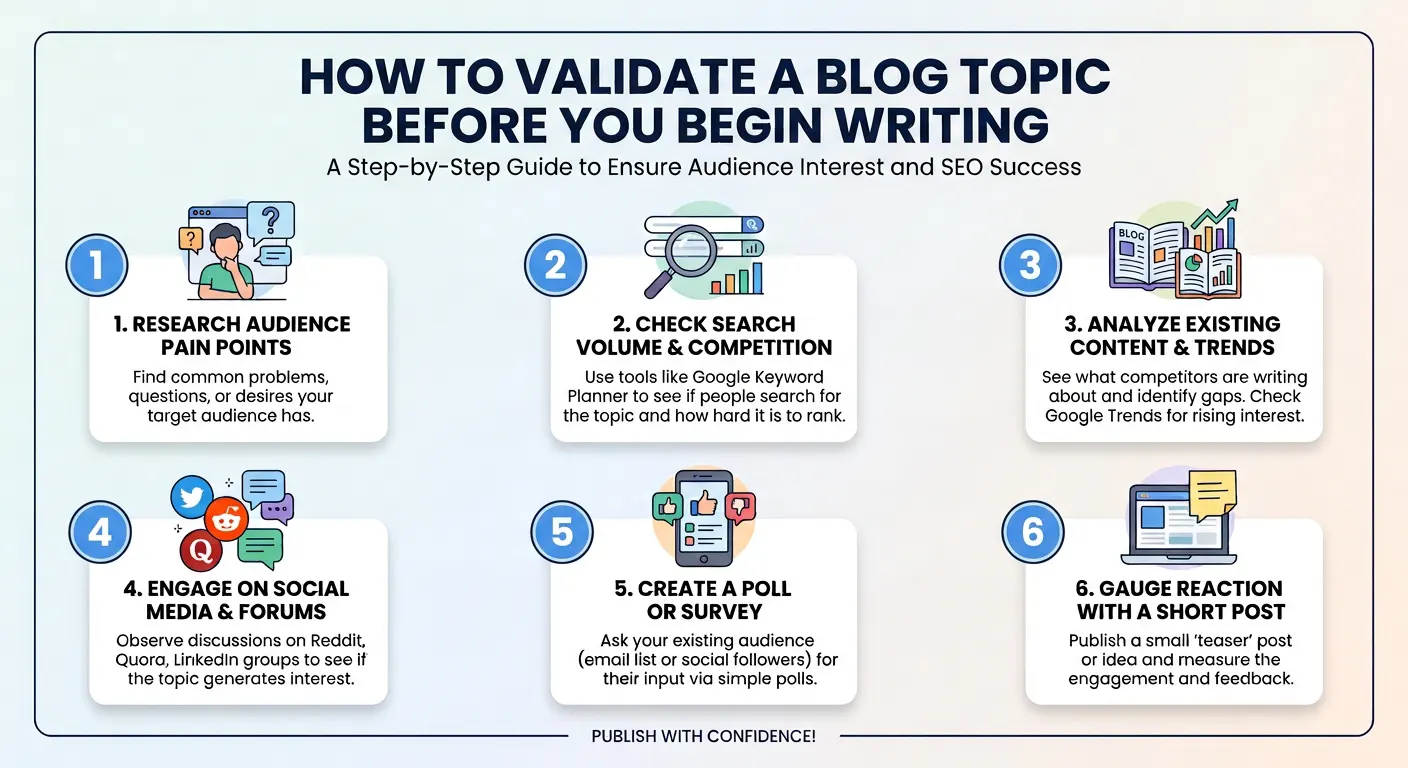
Since you already know that a great blog topic targets the right audience, solves a real problem, and provides value to the readers, you can use this checklist when you want to validate your selected blog topic:
- Make sure your selected topic is relevant to your website’s niche, services, or overall content strategy.
- Make sure your topic targets a particular audience and solves a real query.
- You should also use Google Trends, Ahrefs, or other tools to know how many people are searching for the query you have covered in your blog topic.
- Also, review competitors in your niche and industry to confirm your chosen topic is relevant to a broader audience.
- You should also confirm that your selected topic covers the unique gaps and angles that your competitors or similar blogs miss.
- Lastly, you must verify that the topic you pick provides useful information for your readers.
Common Mistakes People Make When Selecting a Blog Topic
Some mistakes people make when choosing a topic for a blog post include choosing topics that are too broad, focusing only on high search volume, ignoring their target audience, and copying competitors’ exact topics.
Choosing Too Broad Topics
Have you ever read a blog and wondered, ‘It covers everything, yet it’s not useful’? That’s what most people overlook when selecting SEO blog topics. They mistakenly choose a broad topic and cover many things under a general umbrella instead of answering a specific query.
Selecting A Topic Only Because of High Search Volume
Many people use keyword research tools to find topic ideas, but they choose a topic only for its high search volume, hoping to attract more readers without checking whether it fits their website or service.
Ignoring Your Target Audience
Many people choose blog topics that offer great, valuable information, but they still do not resonate with their target readers. That’s because they fail to match or cater to the unique, particular needs of the intended audience.
For instance, your audience wants insights into how your product works, but your blog focuses on your product’s unique features. This way, although your blog provides value, it doesn’t cater to their interests.
Copying the Exact Topics from Competitor Blogs
People analyse competitors by reviewing their high-ranking blogs. Rather than using those blogs to find and cover gaps, they repeat the topics directly. Because these blogs lack a fresh perspective, your content becomes less useful or unique for your audience.
Examples to Turn Your General Idea Into a Strong Blog Topic
You can transform almost any broad idea that comes to your mind into a stronger blog topic using this simple formula:
How to + specific result + your specific audience
If I were to make it a little bit technical,
How to or a listicle guide + specific tips or solutions + to solve a specific problem
Still confused about how to find blog post ideas? You can review these examples.
Example 1
Suppose you think of time management, which is quite a broader term because people can cover almost anything.
To make it a stronger blog topic, you should focus on a specific problem for a specific audience.
Let’s say you target students. So, your blog topic can be,
‘5 Time-Management Strategies for University Students Preparing for Exams.’
Example 2
If you think of healthy eating habits, it is again a broader term.
You can target a specific age group and their specific concerns. Therefore, your topic can be,
‘7 Healthy Eating Habits for Adults over 40 to Support Better Metabolism.’
Example 3
Let’s take another example that can help you get a better idea of how to choose a blog topic. Here, I am keeping fitness as the broader term.
To target a specific audience and problem, you can make your topic,
‘1-Month Home Workout Plan for People Who Prefer Exercising Without a Gym ’
Blog Topic Selection Checklist
I have included a checklist here, so you can quickly review it before you begin with your topic selection process.
- Check whether people search for the exact question or a similar context on Google, Quora, Reddit, social media platforms, and other forums.
- Confirm that your topic provides real value to your target audience by answering the real question or query, or solving a specific problem.
- Make sure you know enough about the topic, and you have a genuine interest in it. This way, you can make it easier to write the entire blog without losing interest.
- You should ensure that your blog topic includes a unique angle that makes it different from competitor blogs.
You Have Selected Your Blog Topic. What’s Next?
By now, I am assuming that you have conducted blog topic research and selected the most suitable topic that aligns with your audience’s interests and answers a specific query.
If you are wondering what exactly the next step is after this, I have answered it for you.
After selecting your blog topic, you have to proceed to research, prepare an outline, and write your blog.
- For research, you will have to search for relevant keywords and search terms that your target audience is most likely to search for.
- Then, you have to map out a proper outline that covers all the relevant gaps and important points you plan to cover in your blog.
- After you have conducted thorough research and prepared an outline, you can begin writing your blog. Here, make sure you use a logical structure, specific tone, language, and writing style that your target readers generally prefer to read. It will help you make your content feel more relatable.
Don’t know where to start or feel puzzled when writing your blog? Then, read our guide on how to write a blog post so that you can have a clear idea of what steps you can follow.
Frequently Asked Questions
How to choose a blog topic that people are already searching for?
To find blog topics that people are already searching for, you should analyse the search engine suggestion feature of Google, try different keyword research tools, and also review the Q&A sections on Quora, Reddit, and other community forums. These can help you map your topic around the genuine queries that people need answers to.
How should I ensure my selected blog topic relates to my target audience?
When you want to be sure that your chosen blog topic relates to your target audience, you should do your best research to understand their core pain point and find certain queries you could provide answers to. Additionally, you should make sure your topic aligns with their specific interests.
How does keyword research help in choosing a blog topic?
With keyword research, you can learn the exact questions and search terms that people are actually using to find information on a particular topic. Because it helps you eliminate guesswork and use real data, you can easily find out relevant content gaps that your competitors have missed. This way, you can select a more relevant topic for your blog.
How to find blog topics that are worth writing about?
To know if a topic is worth writing an entire blog, you can use tools like Google Keyword Planner to determine how many people are searching for this query. You can also explore online forums and social media platforms to confirm whether your topic covers the gaps that most blogs miss. It can help you ensure your topic is worthwhile to write.
Should I make my blog topic broad or specific?
Between broad and specific, you should opt for a specific blog topic. That’s because it can help you target a clear audience, cater to a unique and specific pain point of the readers, and you can also increase your chances of ranking on search engines due to less competition than broader blog topics.
Bringing Everything Together
That brings us to the end of this conversation. I hope this guide can help you learn how to choose a blog topic. Whenever you sit down to select your blog topic next time, make sure that you learn at least one main point from this blog: choose a blog topic that helps you solve a specific problem while offering your readers a solid reason to click.
What I mean is, your blog topic should target a pain point that most blogs generally do not cover properly or fail to answer entirely. It will help you provide value in your content.
Therefore, before you begin writing your blog, spend sufficient time on useful research to explore your audience’s queries, focus on search intent, and analyse your competitors to find gaps so you can save hours spent choosing a topic that no one actually considers useful.


